
The ongoing key reforms such as sops for manufacturing, easier labour laws, wooing FDI inflows and privatisation will help improve productivity and support long-term growth at 7.5-8 per cent levels, which if played out well, can help India contribute 15 per cent of global GDP growth by FY2026, says a report. According to a report pencilled by the India economist at UBS Securities, Tanvee Gupta Jain, the country has the lowest manufacturing costs among peers, even though China retains significant ecosystem advantages and despite that India and Vietnam appear most likely to benefit from a shift out of China.

The government must expedite its plan for asset sale and privatisation, both of which hardly got any mention in the Budget speech, points out A K Bhattacharya.

'In 2022, active management, long-short strategies, multi-asset strategies, and asset allocation strategies need to be considered to meet long-term investment goals.'

With the economy gaining pace and large deals back on the table, chief executive officers (CEOs) of tech companies believe global tech spending will witness growth this year. According to CEO Survey by Nasscom, about 71 per cent chief executives expect global spend to grow over 4 per cent. The figure is significantly higher than the previous two years - 41 per cent and 59 per cent in 2019 and 2020, respectively. The survey also said the recovery in global tech spending will be led by the digital segment.

So, while it is great that India's numbers look relatively good, don't raise a cheer just yet, points out T N Ninan.

As enterprises halt ongoing projects or cancel them, all staffers working on such projects are placed on the bench. In some cases, IT firms have to reduce billable staffers in a project as clients ask for scaling down support, leading to rise in reserved employees.

'Every time a new tech comes in, there are a set of people who will predict that this will be the end of Indian IT and every time the Indian IT industry and overall technology providers have proven to be resilient.'

'The IPO market is cooling off and getting a reality check.'

'Just because you don't see them does not mean they don't exist.' 'The greatest risk is overconfidence.

HCL Tech was the top gainer in the Sensex pack, rising over 4 per cent, followed by HDFC Bank, Infosys, NTPC, Nestle India, TCS and HUL. NSE Nifty surged 337.80 points to 14,845.10.

Even as regulatory focus has zeroed in on foreign e-commerce giant Amazon, a domestic retail giant has been created almost below the radar in Reliance Retail (RR), one of the most crucial businesses for the group's future. From doorstep delivery of groceries, apparels to branded jewellery, medicines, toys, furniture to high street retailing, RR's presence in the world's fourth largest consumer market is just one part of the story.

The headline for corporate profit growth has been very encouraging in the July-September quarter (Q2) of 2023-24 (FY24), with the combined net profit of listed companies up by 38 per cent year-on-year. However, the earnings distribution has been very lopsided, with most of the growth coming from public-sector oil-marketing companies (OMCs), banks, non-bank lenders, automobile (auto) companies, and cement producers. By comparison, companies from information technology services, fast-moving consumer goods (FMCG), retail, and consumer durables were disappointed, experiencing a sharp slowdown in net sales growth and a relatively muted increase in reported net profit.

Ajit Balakrishnan on how to arrest a worldwide decline.

The Centre on Tuesday said it will not seek disclosure of flash sales from e-commerce players to regulate the fraudulent sale of goods and services but will take appropriate action as per the law on consumer complaints. Discount sales that benefit maximum to consumers will continue, but not fraudulent flash sales on the e-commerce platforms, the government said, adding that the e-tailers need not be "anxious" about the draft rules. Ban on fraudulent flash sales, mis-selling and appointment of chief compliance officer/grievance redressal officer -- are among key amendments proposed to the Consumer Protection (e-commerce) Rules, 2020, on which the government has sought public comments by July 6.

'As we expect the economy to continue to grow above the trend line, we expect capex decisions to be taken next year when there is more certainty about the cost of funding and the economy.'

'Short term volatility is likely due to various factors, global and domestic; investors may use this as an opportunity to increase the allocation to equities.'

Experts pointed out the move will only help taxpayers temporarily, as the tax liability remained the same and the date for advance tax has not been extended.

A weak dollar sentiment across the board alongside unwinding of long positions by speculative traders ahead of key US macro data release largely supported the rupee

'Today, there is no easy money to be made after the run-up in equities.'

India's gold demand recovered during the January-March period to witness a growth of 37 per cent at 140 tonne compared to the same quarter of 2020, due to ease of COVID-related restrictions, pent up demand and softening of prices of the yellow metal, according to the World Gold Council (WGC). The overall gold demand stood at 102 tonne during the first quarter of 2020, as per WGC data. Gold demand in value terms increased by 57 per cent during the first quarter of this calendar year to Rs 58,800 crore compared to Rs 37,580 crore in the corresponding period of 2020.

Following an active lifestyle rather than a sedentary one is essential to eliminate risk of diseases.

His about-turn in the farm laws proves that he sees everything in just one dimension: Politics. That helps sometimes. But not always, observes T C A Srinivasa-Raghavan.

In the aftermath of the Karvy incident, lending against third-party collateral facility raises questions over regulations concerning banks and brokers which are at loggerheads. While Sebi and NSDL have ordered the transfer of securities, which were kept as collateral, lenders followed the old business model of sanctioning loan against shares and allegedly overlooked certain parameters. Legal experts feel that this could lead to a collapse of the loan-against-shares market as it raises questions over the sanctity of the pledged securities.

Revenue buoyancy of GST will be key to improve the resource position of both central and state governments.

Reversing the burden of evidence means that the principle of innocent until proven guilty does not apply. It is exactly the opposite: Guilty as charged, until you can convince the judges of the contrary, points out Shekhar Gupta.

'We would advise investors to invest in a disciplined way in equities for the long term.'

While Wipro leads the pack on absolute numbers, analysts for Infosys for reporting consistent growth, revising FY22 guidance and beating TCS on revenue growth.

It is nearly after 13 years that a foreign brokerage has resumed holistic coverage on stocks of public sector banks (PSBs). To that extent, Morgan Stanley's report dated March 3, where the analysts have listed their order of preference for PSB stocks, is an indication that the state-owned banks may once again be attracting some interest, thanks to three back-to-back quarters of good results in FY21 so far. "State-owned banks' balance sheets have improved, and bad loans formation should moderate going forward," the analysts note and this is the key reason for them to relook at their stance on PSBs. While State Bank of India (SBI) remains their preferred pick, stocks of Bank of Baroda (BOB) and Punjab National Bank (PNB) have been upgraded from 'underweight' to 'equal-weight'. The brokerage maintains its underweight recommendation on Bank of India and Canara Bank.

Corporate India lags the rest of its Western and Asian peers by a wide margin when it comes to the presence of women on their boards, with just 17.3 per cent of the large companies having them on their key decision making bodies, an international report said on Tuesday. However, this is a near 6 percentage points improvement between 2015 -- when it was only 11.4 per cent -- and 2021, Swiss brokerage Credit Suisse said in the report, which covered over 33,000 executives from more than 3,000 companies across 46 countries, including over 1,440 firms across 12 Asia-Pacific markets. Female representation on boards of large Indian companies has increased by 5.9 percentage points from 11.4 per cent in 2015 to 17.3 per cent in 2021.

'To get success in business one should know how to create and attract talent and how to retain it.'

'Large-caps are better placed to withstand the impact of higher input cost inflation, rising rates and withdrawal of excess global liquidity.'

HR experts estimate that up to 70 per cent companies in the manufacturing and services space including sectors like auto components, edutech and construction equipment are looking to restore the salary cuts over the next couple of months.
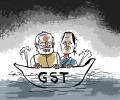
Agra has long been known for the Taj Mahal, but it is also a manufacturing hub filled with micro, small and medium enterprises (MSMEs) that make everything from electronic components to metal products, from paints and chemicals to footwear. And five years after the introduction of the Goods and Services Tax (GST), the MSMEs here complain that while the indirect tax regime has been transformative, cutting out the need to file multiple taxes, its biggest drawback has been the delay in credit refunds. Whoever you speak to - MSME owners, tax lawyers, or industry bodies like the National Chambers of Industries and Commerce (NCIC), Agra Footwear Manufacturers and Exporters Chamber (AFMEC) and Agra Shoe Manufacturers Association (ASMA) - they all emphasise that the GST continues to face some key challenges.

'As CIC, you have the power to comment on policy matters. 'If you have very strong beliefs and you know your rulings will be reported, you will express your beliefs.'


As he projected a grim outlook for the economy, RBI Governor said that amidst this encircling gloom, agriculture and allied activities have provided a beacon of hope on the back of an increase of 3.7 per cent in foodgrains production to a new record.

Gold, which lost its sheen to some extent in the second half of 2021, is likely to regain the glitter in the New Year and cross the Rs 55,000-per-10-grams level amid pandemic woes, inflation worries and stronger US dollar. After a stellar run up in 2020 when the yellow metal touched a record high of Rs 56,200 on the MCX in August, the prices are near Rs 48,000 per 10 grams now. This is roughly 14 per cent lower from the all-time highs and 4 per cent lesser compared to January 2021 levels.

The upward revision in growth forecast for current fiscal comes in the backdrop of GDP expanding 8.2 per cent in April-June quarter, higher than Fitch's expectation of 7.7 per cent.

Waves of foreign portfolio investments worth over Rs 51,000 crore splashed into the Indian market in 2021 as overseas investors turned net buyers of domestic securities for the third straight year while excess global liquidity and other factors steered the ebb and flow of their investing ways. With the global financial system still flush with liquidity, emerging market assets, especially equities, might well remain the preferred investment avenue for many more months to come, experts opined. As the equities sizzled during most of 2021, that also saw economy slowly coming back into the recovery path, Foreign Portfolio Investors (FPIs) turned net buyers but their investment is much less compared to net inflows of Rs 1.03 lakh crore in 2020.

The high point of the trip will be Goyal's meeting with US Trade Representative Robert Lighthizer on November 13, which is expected to see the USTR push India towards lower import duties in a broad range of areas.
